 |
There has not been a holy revolution which was distorted as
much as the shi'ites distorted the revolution of Al-Hussain in the pretext
of loving him, Further more these ceremonies are the cause of bloody conflicts
between the shi'ites and the Sunnis of Pakistan, where hundreds of
innocent people from both sides have been killed. I feel it is very
important that people should know what is the reality of MATAM. The
Tradition is still common in the gathering held for Imam Hussain in the
Shi'ites world, It is imperative to end these gatherings by weeping for
Al-Hussain because "He who cries or tries to cry for Al-Hussain,
Heaven becomes obligatory for him" This is a statement which is
found in the books of narrations and is attributed to the Imaams. But God
forbid that |
|
such a statement should have come from an Imaam. The Boyheys,
who ruled Iran and Iraq in the name of protecting the khilafah of
Banu-Al-Abbas, played a vital role in strengthening the tradition of
celebrating the day of 'Ashura'. However, celebrating the day of 'Ashura'
became a general tradition and a part of the Shi'ites existence during the
time of Shah Ismail Al-Safawi. He forced Iran in to Shi'aism and created
in it a denominational unity to squench the desires of the neighboring
Ottoman KHILAFAH. In the Safawi palace, every year the first ten days of
Muharram used to be declared as days of mourning and the Shah used to
receive the mourners on the day of 'Ashura'. On that day a special
celebration used to be held in the royal palace. Many people used to
gather for those celebrations, and the Shah himself used to attend
them
also, Shah Abbas Al-Safawi, whose rule lasted for fifty years and who was
the shrewdest most powerful and most cruel of the Safawi Shahs, used to
wear black on the day of 'Ashura' and put mud on his face as a sign of
mourning for Al-Hussain. He used to lead the marchers in the streets, But
We do not know for sure when the |
|
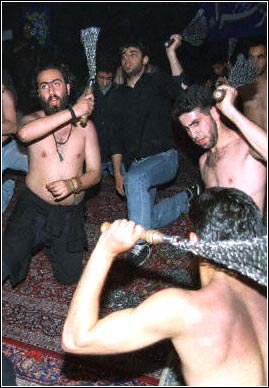
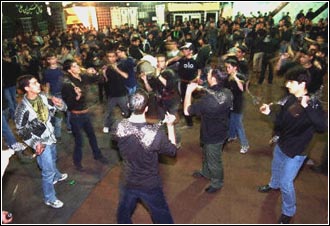
tradition of striking the
shoulders with
chains on the day of 'Ashura' came into existence. This tradition
spread into Shi'ites areas such as Iran and Iraq, and other region as
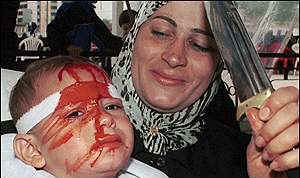
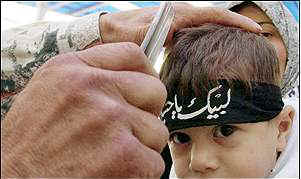
well. However, there is no doubt that striking the heads with swords and
causing blood to gush out as an act of mourning for Al-Hussain on the day
of 'Ashura' came to Iran and Iraq from India during the British occupation
of those countries. The British exploited the ignorance, simplicity and
the great love the Shi'ites had for Al-Hussain. |
 |
|
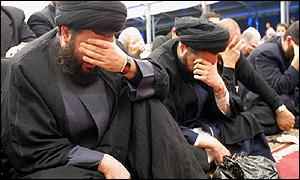
They even taught them
to hit their heads
with sharp objects. Until very recently, the British embassies in both
Tehran and Baghdad used to finance the demonstrations for Al-Hussain. This
demonstration portrayed an ugly image in the streets and neighborhoods.
The purpose behind the British colonial policies in their support for this
ugly tradition, which has been grossly exploited by them,was to provide
an acceptable justification to the British people to counteract the
opposition by some independent newspapers and by some countries against
the British occupation of India. The people of these countries were made
to appear as savages who needed a civilizing force like the British to
teach them human values and liberate them from ignorance and savagery.
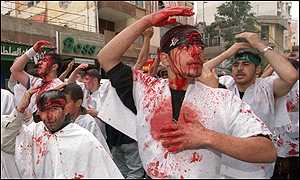
British and European newspapers used to publish |
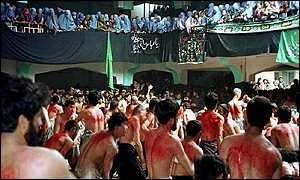 |
pictures of the
demonstrators marching in the streets on the day of 'Ashura' with
thousands of people hitting their shoulders with chains until they bled,
and striking their heads with swords and other sharp objects until blood
gushed out. The policy makers of the colonial powers used to use these
pictures to justify the colonization of these countries under the pretext
of wanting to educate the people of these countries and bring them toward |
|
civilization and progress, as dictated by their feelings of moral
obligation towards their fellow human beings. It is said that once
Yasin Al-Hashmi, the Prime Minister of Iraq during the British occupation
of that country, visited London to negotiate with the British to end their
occupation of his country. The British said to him :"We are in Iraq to help the Iraqi people achieve happiness
and give up savagery." This statement caused |
![whether a cultured nation even with degree of civilization would do this to itself [Is This you Call Islaam?] [Matam] [Allaahuakbar.net]](../image/shiite_ismaeili.jpg)
|
 |
the Prime Minister
to become angry and he left the room where they were holding the
negotiations. The British politely apologized to him and respectfully
asked him to see a documentary film about Iraq. When he watched the
film, it turned out to be a film of the demonstration held on the day of
'Ashura' in the streets of Al-Najaf, Karbala and Al-Kazimiyah. The film
was full of horrible and sickening scenes which included |
|
striking the
bodies with chains. The British, by showing that film to the Prime
Minister were asking him whether a cultured nation even with degree of
civilization would do this to itself This article is taken from a
scholar of Iran Imam Dr. Musa Musawi. Here I want to mention something
amusing, yet full of wisdom and bright ideas. I heard it from one of the
Shi'ite scholars and religious |
 |
 |
leader about thirty years ago, This elderly
and respected man was standing beside me, The day was the tenth of
Muharram and the time was noon and the place was the Rawdah of Imam
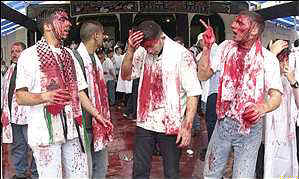
Al-Hussain in Karbala. Then a demonstration of those who strike their
heads with Swords and Causes blood to gush out of their heads as a sign of
grief and mourning for the death of Al-Hussain entered in great |
|
numbers to the grave site of Al-
Hussain. Their blood flowing down their foreheads and
the sides of their bodies in a sickening way caused one's body to shiver.
Then another large group of people who were hitting their backs with
chains until they bled, That is when the old man, an independent scholar
asked me "what is the matter with these people who have inflicted
this disaster and pain on themselves?" |
![whether a cultured nation even with degree of civilization would do this to itself [Is This you Call Islaam?] [Matam] [Allaahuakbar.net]](../image/shee'ee_imaamah.jpg)
|
 |
I said : "you have
asked this question as if you are not listening to what they are saying,
which is, 'O Hussain,' expressing their grief for him. Then he asked again: Isn't Al-Hussain now
'firmly established in the favor of a Mighty King.' I said yes. Then
he asked me again: Is not Al-Hussain now at thismoment in a 'garden
whereof the breadth is as the breadth of the heavens and the earth, which
is the reward for those who ward off evil'? I said |
|
yes. Then he asked:
Aren't there in paradise 'fair ones with wide, lovely eyes, like unto
hidden pearls'? I
said yes. Then he took a deep breath and said in a
forceful way with pain and sadness: Woe to them, stupid, ignorant, for
what they do to themselves, for an imam who is now in the 'gardens of
delights, there wait on them immortal youths with bowls and a cup from a
pure spring.' In the year 1352 A.H., when the leading scholar
|
![whether a cultured nation even with degree of civilization would do this to itself [Is This you Call Islaam?] [Matam] [Allaahuakbar.net]](../image/shiites_borah.jpg) |
|
of the
Shi'ites of Syria, Hassan Al-Amin Al-Ameli, declared such acts to be forbidden, which
was an unmatched demonstration of courage on his part in stating his
opinion and by asking the Shi'ites to stop these practices, he was faced
with strong opposition from within the ranks of the Shi'ia scholars,
religious leaders and those who followed them, the kind of people
described by Imam Ali (R) as "rag-tag and bobtailed."
This step of the reform
almost failed had it not been adopted by our grandfather Abu-Al-Hassan,
who was the supreme leader of the Shi'ite denomination. Abu-Al-Hassan had
the same view as Al-Amin, and he declared his full support for him and his
ruling concerning that issue. The stand taken by our grandfather
gave great strength to the reform movement of Al-Amin. Even though many of
the Fuqaha and Mujtahedeen opposed Abu-Al-Hassan was able to defeat all
who opposed him due to his great status and perseverance. The public started to listen to
the ruling of the great leader concerning religious matters, and their
accustomed practice during the day of 'Ashura' started to diminish little
by little and began to disappear from the Shi'ites' lives. However, these
practices did not completely vanish and
|
![whether a cultured nation even with degree of civilization would do this to itself [Is This you Call Islaam?] [Matam] [Allaahuakbar.net]](../image/shiite_mahdi.jpg) |
weak traces of them remained until
the death of our grandfather in the year 1365 A.H. (may Allah's Mercy be
upon him). After his death, the new Shi'ia authorities started to urge
people to practice these traditions again. These
traditions made a comeback in the Shi'ite world; however, they did not
reappear to the same level as in the era prior to 1352 A.H. After the Islamic
republic was declared in Iran and the
|
|
concept of Walaayet Al-Faqeeh
became the basic of power, orders were given to revive those traditions as
part of the policies of the Shi'ite denomination. Furthermore, the young
Islamic republic began helping the Shi'ite groups in all parts of earth,
both financially and spiritually. It urged them to revive this invention
which was brought into the Shi'ite Muslim world about 200
|
 |
 |
years ago by the policies of the colonizing British, in order to
give Islaam and Muslims the worst image and to justify their occupation of
the Muslim countries, as we mentioned earlier. As I am writing these
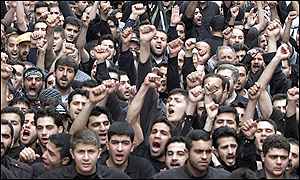
lines, the cities of Iran, Pakistan, India and Lebanon unfortunately
witness on the tenth of Muharram every year a
|
| processing of people
marching in their streets in the image we drew. Before the end of that
day, many picture of that human savagery and terrifying foolishness are
shown on the T.V. screens in both the east and the west to give strength
to the enemies of Islam and to those who wish ill towards Islam and
Muslims. Therefore, We must enrich ourselves in memory of Al-Hussain
rather than destroying ourselves. we must give to Al-Hussain his respected
place in the arena of struggle instead of tarnishing and defaming status.
We must do this if we truly among the supporters of Al-Hussain and those
who Love him.
The
similarity between SHI'ITES rituals and Christian rituals
|




![Islaam pure and clear, that is according to the Qur'ân and the authentic Sunnah the way of the Salaf [ http://www.allaahuakbar.net ]](../image/question.jpg)
